
Jette Clover
Jette Clover
Artist Statement
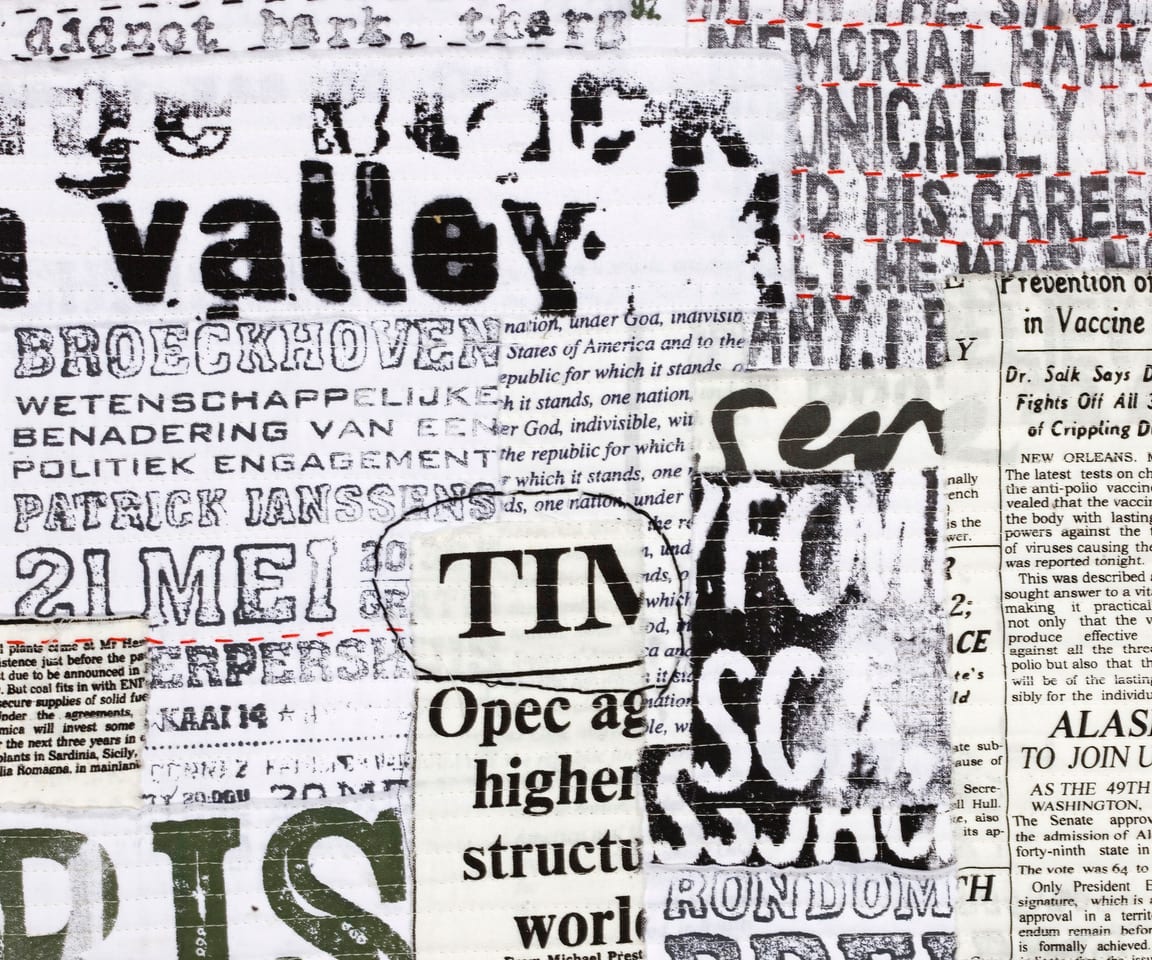
I am inspired by published text in different languages, handwritten letters and the urban communication on city walls – faded signs, tattered posters, flashy advertisements and bold graffiti.
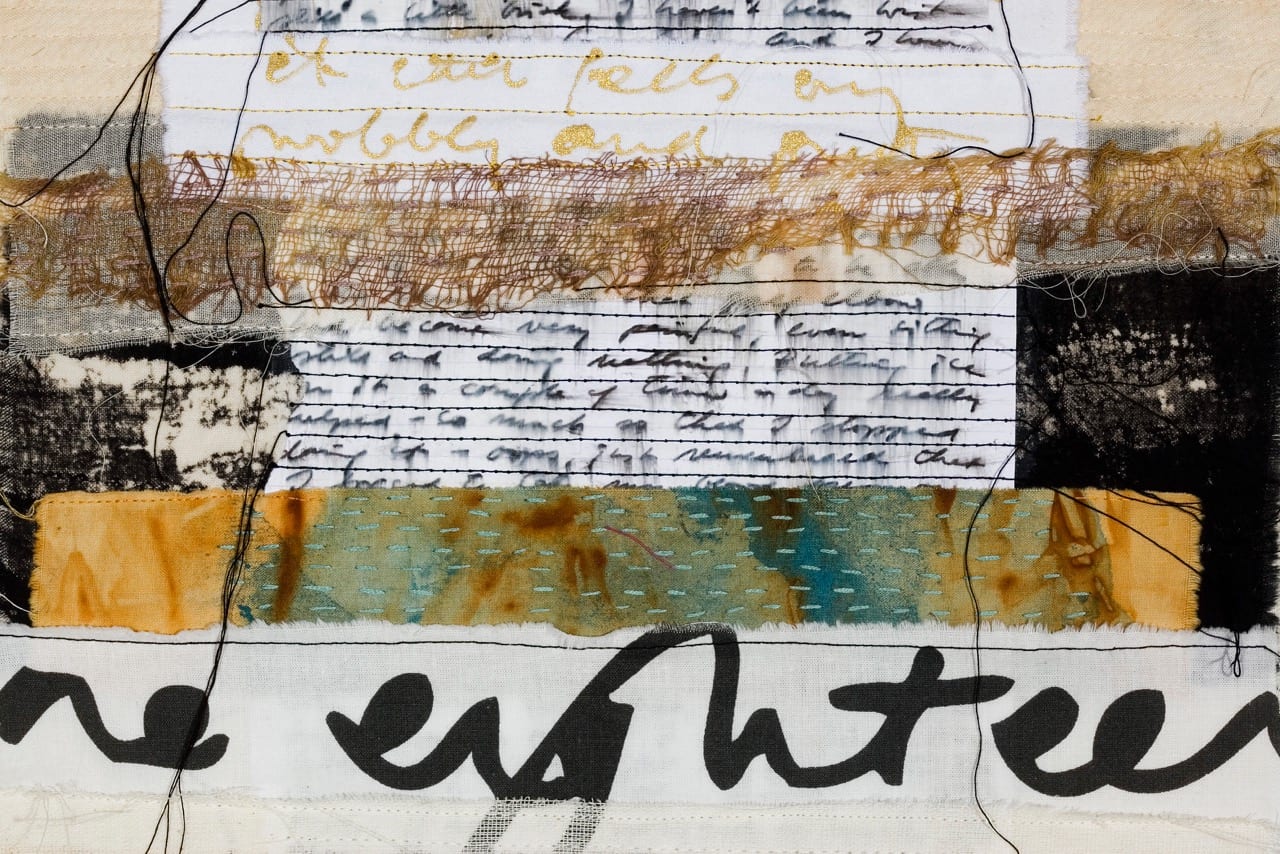
My work is collage constructions, often in monochromatic tones. I combine cotton, linen, silk, cheese cloth and paper to which I apply a variety of surface design techniques and extensive stitching
Exhibitions
Borders: Master class with Jette Clover
Jette Clover
Artists cross borders in new exhibition
Borders are confronted, interpreted and defined by nine textile artists in a new exhibition opening at Newcastle’s Timeless Textiles Gallery in October.
The Crossing Borders exhibition displays the results of a masterclass taught by Danish fibre artist and teacher Jette Clover. Conducted over nine months, the masterclass encouraged the students to explore the literal, political, cultural, symbolic and psychological meaning of a border.
They experimented with techniques and materials to visually express borders through lines, seams, folds, shadows, colours, and textures.
A border makes distinction between adjoining elements and spaces, and can either separate or link those elements and spaces. In everyday usage, border most often refers to a physical obstruction. It is associated with cultural and political diversity. Borders often mark language barriers and can create feelings of inside/outside and us/them.
A journalist before she became an artist, Clover helped her students to also consider those invisible borders that affect us, personally and collectively. Personally, we can be limited by fear, lack of time and means, change, gender role and family. Personal borders can stop us from developing our full potential. Communities can also create social, psychological, emotional and ethical borders. Crossing them can bring about positive changes, on an individual or societal level. For instance, the #MeToo movement empowered women to break down barriers of silence about sexual harassment.
The exhibiting fibre artists include Peta Llyod, Wilma Simmons, Cathy Jack Coupland, Margaret Adams, Anne Kempton, Jenny Broughton, Lois Parish Evans, Nanette Blachin and Jenny Florey. They have responded in diverse and creative ways to the challenge of breaking their personal borders.
Crossing Borders exhibition runs from 3 to 28 October. Jette Clover will open the show from 6 to 8pm on Thursday 4 September
Find out more about Jette
Linguistic Marks: Els van Baarle & Jette Clover
Jette Clover
Text becomes art in Linguistic Marks – a new joint exhibition.
Two internationally renowned artists, Els van Baarle and Jette Clover, unite for their first Australian exhibition at Newcastle’s Timeless Textiles Gallery in November. Their Linguistic Marks exhibition combines the diverse styles of the two highly-skilled artists around the common theme they share – a love of text and writing.
Textile artist/teacher from the Netherlands, van Baarle, teaches surface design classes all over the world. Her work, widely published and collected, has won many awards and prizes. Her large scale art-cloth pieces are inspired by ancient history and traces of the past.
“I love the slow process of using wax and dye many times, to recreate the wear and tear of time,” she said. “The result is a wonderful cloth with a wealth of colour and depth.”
Van Baarle’s work brings together tradition and innovation. Text plays an important part.
Clover was born in Copenhagen but lived and worked in the US and the Netherlands before settling in Antwerp, Belgium. Educated in journalism and art history, her career includes working on a daily newspaper in Copenhagen and running an art gallery in Los Angeles. She was curator at the Dutch Textile Museum for over 10 years, where she organised the first European Art Quilt exhibition in 1997. Working as a studio artist since 1998, Clover has exhibited widely in USA, Europe and Asia.
“I was a journalist before I became an artist, which is why almost all my art work contains pieces of text,” Clover said. “I am inspired by mark–making both in the form of handwriting and the layered and fragmented words and letters in the urban landscape – faded signs, tattered posters, flashy advertisements and bold graffiti.”
Both artists share a love of old books and documents. They are curious about what survives or endures the passage of time. Text as image, text as a vehicle for meaning and the tactile nature of embroidered signs and symbols are all central elements of their work.
Van Baarle’s pieces explode with vibrant colour, while Clover keeps a more subdued palette of white, grey and black. Their pieces are often stitched by hand, before or after painting and printing, to create visual marks of time and a textural quality.
Find out more about Els and Jette
Shop
Workshops
SCRATCHES, SMUDGES AND SPLASHES – Making marks with Jette Clover
Course Overview
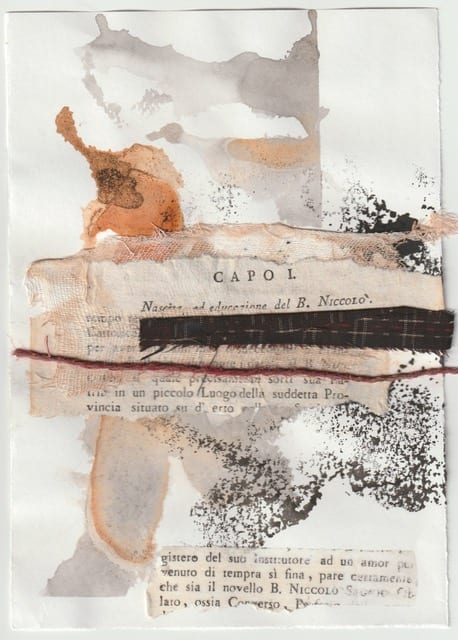
Marks can be familiar signs such as numbers and letters, and they can be personal symbols or plain doodling. Your signature for example is a mark that is unique to you. This workshop introduces fun and experimental techniques,which can be applied to both paper and fabric.
We will experiment with drawing, painting, printing, rubbing, scraping and staining. We will explore monoprinting, stenciling and screening with a variety of resists such as paper, fabric, string, glue, wax, gel medium, etc. We will further use gelatin as a base for making a printing plate and use our hands as a press. Besides paint we will be using tea, coffee, ink and bleach for mark making
Teacher Profile
I was a journalist before I became an artist, and almost all of my art work contains text and lettering. I like words, both because of their graphic quality and because of their ability to convey meaning.
I am inspired by published text in different languages, handwritten letters and the urban communication on city walls – faded signs, tattered posters, flashy advertisements and bold graffiti.
My work is collage constructions, often in monochromatic tones. I combine cotton, linen, silk, cheese cloth and paper to which I apply a variety of surface design techniques and extensive stitching.
Materials List
SCRATCHES, SMUDGES AND SPLASHES
- block of water color paper, 200 g, A-3 size
- couple of old magazines
- papers that you find interesting – drawings, old letters, music and book pages, shopping lists, tickets, wrapping paper, transparent silk paper, etc.
- black/white photo copies of text and images you find inspiring
- ½ meter white cotton
- small assortment of fabric scraps
- cheap sponge
- sheet of sandpaper, fine
- glue stick
- masking tape
- acrylic paint – white, black, yellow, blue, red
- plate or styrofoam tray for mixing paint
- brushes and rollers
- spray bottle for water
- plastic spoon
- old credit card
- brayer (if you have one)
- bone folder (if you have one)
- set of (cheap) water colors (if you have it)
- black marker(s)
- scissors, thread, embroidery floss, needles
- disposable gloves
Workshop Terms
While our fibre art workshops are usually held in the gallery's historically significant workshop space, the workshop venue may change according to the needs and wishes of the artist tutor. Likewise, the times of the workshops may vary depending on the type of workshop and its presentation.
Timeless Textiles Gallery will, at its own discretion, where a participant is unable to attend a fibre art workshop, an exchange or credit note will be made available or a refund of the deposit or payment in accordance with the following Workshop Refund Policy.
Major commitments must be met, and in fairness to all, the policy concerning the refund is:
Cancellations 3 months prior to workshop date - refund 80% fees paid
Cancellations 2 months prior to workshop date- refund 50% fees paid.
Cancellations 1 month prior to workshop date- no refund.
EXPERIMENTAL SCREEN PRINTING with Jette Clover Sold Out
Course Overview
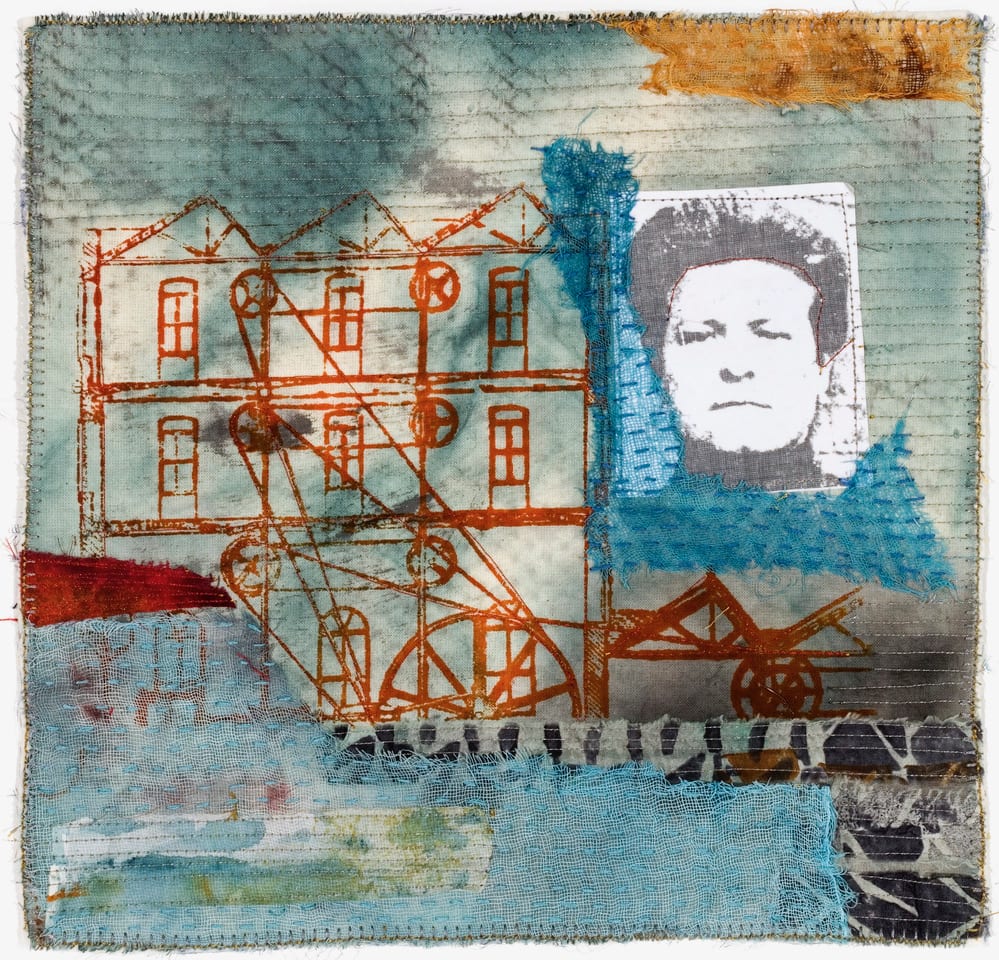
This workshop introduces fun and non-toxic printmaking methods, which can be used on both paper and fabric
We will explore the possibilities of various printing techniques such as mono printing, stencil printing, screening, rust – and flour printing and discharge. We will experiment with a variety of resists including paper, plastic, textile, string, wax, flour, acrylic gel medium, etc. We will construct our own screens and further use gelatin as a base for making a printing plate and our hands as a press
Teacher Profile
Jette was born and raised in Copenhagen, Denmark, but she has lived and worked for many years in the US and the Netherlands. Since 2005 she has been living in Antwerp, Belgium.
Her formal education is in journalism and art history. She has worked on a daily newspaper in Copenhagen, had an art gallery in Los Angeles,
California, and later was curator at the Dutch Textile Museum for more than 10 years, where she organized the very first European Art Quilt exhibition in 1997.
Since 1998 she has worked full time as a studio artist. She has exhibited widely in USA, Europe and Asia, and she is a sought after teacher for workshops in surface design.
Jette has been a member of the European group Quilt Art since 2000, and since 1998 she has been a member of SAQA (Studio Art Quilt Association) and served as the international representative for three years.
Materials List
Supply list:
3 m white cotton
A small amount of different fabric scraps.
Spray bottle
Textile paint or acrylic paint
Plate or tray for mixing paint.
Brushes and rollers
A couple of ‘found objects’.
A couple of rusty objects
Painter’s tape or masking tape.
Brayer
Old credit cards
Plastic spoon
Scissors
Glue stick
Black marker
Stencils(if you have them)
Thermofax screens(if you have them)
Block of water color paper, A-3
Old magazines and old newspaper
Old towel (to make printing surface)
Sewing materias: pins, needles, thread
Workshop Terms
While our fibre art workshops are usually held in the gallery's historically significant workshop space, the workshop venue may change according to the needs and wishes of the artist tutor. Likewise, the times of the workshops may vary depending on the type of workshop and its presentation.
Timeless Textiles Gallery will, at its own discretion, where a participant is unable to attend a fibre art workshop, an exchange or credit note will be made available or a refund of the deposit or payment in accordance with the following Workshop Refund Policy.
Major commitments must be met, and in fairness to all, the policy concerning the refund is:
Cancellations 3 months prior to workshop date - refund 80% fees paid
Cancellations 2 months prior to workshop date- refund 50% fees paid.
Cancellations 1 month prior to workshop date- no refund.
Videos
Shop
Showing all 2 results

